Every few weeks somebody who used to play for me texts a photo of a supplement label and asks what half the words mean. So I built this page the way I used to build a scouting report before a Friday night game — pull every player (ingredient) out on their own, note where they actually came from, and write down what the game tape says instead of what the highlight reel promises.
A couple years ago I dropped about six weeks and $80 on a SAMe supplement because a guy at the gym swore by it. My stiffness notebook barely moved the whole time — and it turns out the largest review of the SAMe evidence found people taking it did no better than people taking a sugar pill. I wish I'd had a table like this one before I bought the bottle.
So this isn't a "these definitely work" page. It's the roster sheet — sourcing, standardization, what the actual trials measured — for the ingredients that keep showing up in the products I test and log. Where the evidence came back thin or flat-out null, I say so, same as I'd tell a kid he's not starting Friday. I'm not a doctor (obviously — see: thirty years of ignoring my own knees), just a guy cross-checking labels against the literature in a spiral notebook.
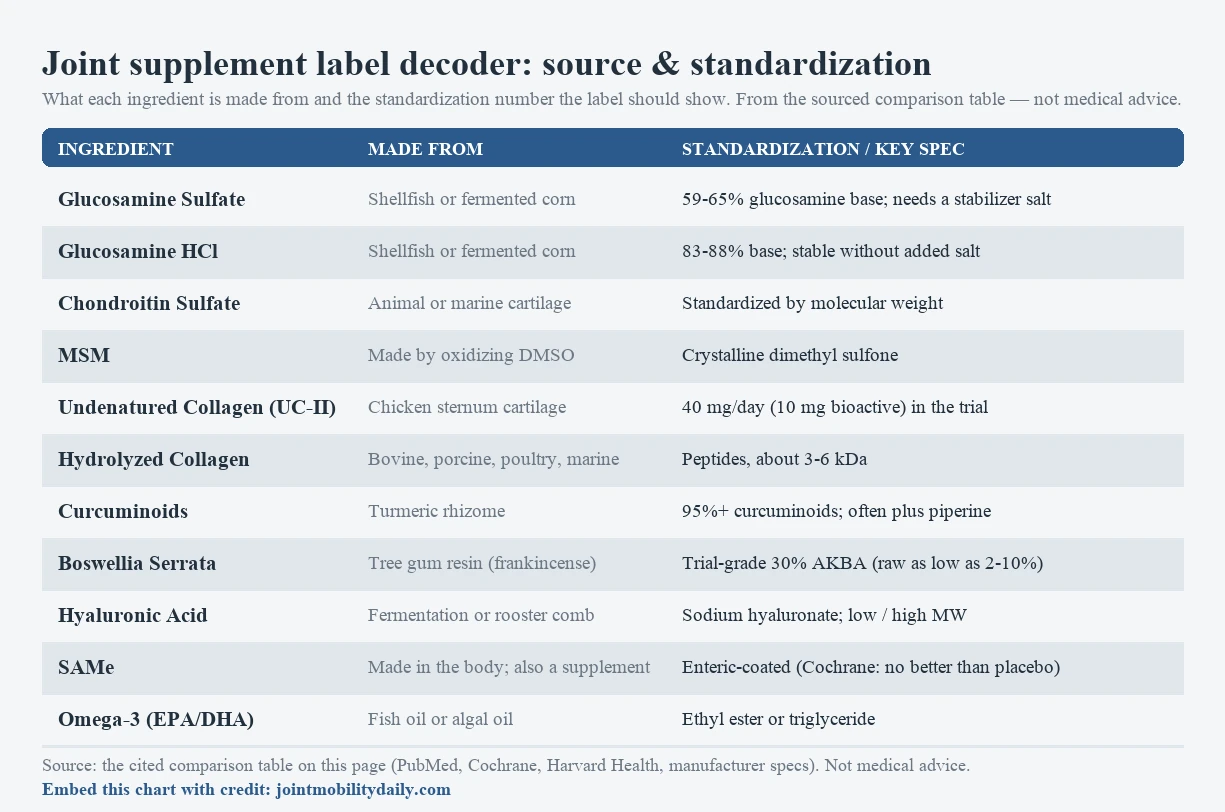
The number most labels bury: the branded boswellia extracts used in the human knee-osteoarthritis trials that showed pain improvement were standardized to 30% AKBA — while raw or preclinical material has run as low as 2–10%. Same plant, potentially very different product. If the label doesn't print the AKBA percentage, you can't tell which grade you're holding, and neither can I.
Comparison of Joint-Support Ingredients
Here's the roster — every ingredient I keep running into on joint-supplement panels, lined up side by side with where it comes from and what the standardization number on the label should actually say.
| Ingredient | Primary Source(s) | Biological Role / Mechanism | Standardization / Common Forms |
|---|---|---|---|
| Glucosamine Sulfate | Shellfish chitin (traditional) or fermented corn (vegan) [1] | Precursor for glycosaminoglycans (GAGs) in cartilage matrix. | Unstable on its own; requires a second stabilizer salt (KCl or NaCl); ~59–65% glucosamine base by weight [1]. |
| Glucosamine HCl | Shellfish chitin or fermented corn — virtually all vegan glucosamine on the market is sold in this form [1] | Structural precursor for joint tissue repair. | Stable without an added stabilizer salt; ~83–88% glucosamine base by weight [1]. |
| Chondroitin Sulfate | Bovine, porcine, or chicken cartilage, and marine cartilage from sharks and other cartilaginous fish [2] | Provides resistance to compression; inhibits degradative enzymes. | Often paired with glucosamine; standardized by molecular weight. |
| MSM | Naturally occurring in the environment; commercially manufactured by oxidizing DMSO with hydrogen peroxide [3] | Organic sulfur donor used as a complementary/alternative-medicine anti-inflammatory [3]. | Methylsulfonylmethane (crystalline dimethyl sulfone). |
| Undenatured Collagen (Type II) | Chicken sternum cartilage [4] | Believed to work through oral tolerance — gut-associated lymphoid tissue exposure to the intact collagen epitope appears to dial down the immune system's attack on joint cartilage [5]. | Commonly branded UC-II®; the published human knee-osteoarthritis trial dosed at 40 mg/day (containing 10 mg of bioactive undenatured type II collagen) [4]. |
| Hydrolyzed Collagen | Bovine, porcine, poultry, or marine [6] | Broken down via hydrolysis into peptides that serve as building blocks for connective-tissue synthesis [6]. | Collagen peptides; molecular weight typically 3–6 kDa [6]. |
| Curcuminoids | Turmeric rhizome (Curcuma longa), part of the ginger family [7] | Blocks NF-κB activation and inhibits ROS-generating enzymes such as lipoxygenase/cyclooxygenase [8]. | Standardized to a minimum 95% concentration of the three curcuminoids (curcumin, bisdemethoxycurcumin, demethoxycurcumin); often paired with piperine, which has been shown to raise curcumin's bioavailability by as much as 2000% [8]. |
| Boswellia Serrata | Gum resin of the tree, also called Indian frankincense [9] | AKBA is the most potent inhibitor of 5-LOX among the boswellic acids [10]. | Raw/preclinical test material has run as low as 2–10% AKBA; the patented high-potency extracts actually used in human knee-osteoarthritis trials (5-Loxin®, Aflapin®) are standardized to 30% AKBA — a big gap the label doesn't always spell out [10]. |
| Hyaluronic Acid | Bacterial fermentation (particularly Streptococcus zooepidemicus) or rooster combs [11] | Its shear-dependent viscosity has long been considered ideal for joint lubrication, though some researchers have disputed how much this actually matters for lubrication in the living joint; it also plays a protective role for joint tissue during motion [12]. | Sodium Hyaluronate; varying molecular weights (low vs. high). |
| SAMe | Endogenous molecule, produced naturally in the body and also sold as a supplement [13] | Proposed mechanisms include direct or indirect signaling of cartilage synthesis/survival and maintenance of DNA methylation [14]. That said, a Cochrane systematic review found people taking SAMe for osteoarthritis responded no better than people taking a placebo — a 0% difference in response rate, on evidence rated low-to-moderate quality [13]. | S-Adenosyl-L-methionine; requires enteric coating for stability. |
| Eggshell Membrane | Membrane of chicken (hen) eggs [15] | Naturally contains glycosaminoglycans — including chondroitin sulfate, dermatan sulfate, keratan sulfate, and hyaluronic acid — plus bioactive collagen types I, V, and X [16]. | Often branded as NEM®; typically standardized to a 500 mg daily dose [16]. |
| Omega-3 (EPA/DHA) | Fish oil is the most prominent dietary source; algal oil is the direct vegetarian/vegan alternative [17] | EPA and DHA are the biosynthetic precursors of specialized pro-resolving mediators (SPMs) — resolvins, protectins, and maresins — involved in actively resolving inflammation [18]. | Concentrated ethyl esters or triglycerides; EPA:DHA ratios vary. |
Detailed Mechanisms and Characteristics
- Glucosamine Payload Differences
- Glucosamine HCl provides a higher percentage of active glucosamine base per milligram (~83–88%) than Glucosamine Sulfate (~59–65%), because the sulfate form is unstable on its own and needs an added stabilizer salt such as potassium or sodium chloride [1].
- Collagen Types and Bioavailability
- Undenatured Type II collagen (UC-II) is not primarily a structural amino-acid source the way hydrolyzed collagen is — its proposed value is immunomodulatory, working through gut-associated lymphoid tissue interacting with the intact collagen epitope to encourage oral tolerance and dial down the body's own attack on joint cartilage [5]. Hydrolyzed collagen, by contrast, is broken down into much smaller peptide fragments (3–6 kDa) meant for direct absorption and use as raw building material [6].
- Botanical Standardization (AKBA and Curcuminoids)
- Boswellia's AKBA content varies enormously by grade: raw or preclinical test material has been used at concentrations as low as 2–10%, while the branded extracts used in the human knee-osteoarthritis trials that actually show pain improvement (5-Loxin®, Aflapin®) are standardized to 30% AKBA [10]. Turmeric extracts are typically standardized to a minimum 95% curcuminoid content, and piperine is commonly added because — per the review literature — it can raise curcumin's bioavailability by as much as 2000% [8].
Where This Table Actually Earns Its Keep
I don't add anything to my own rotation because a table cell looks impressive. Before I try a product, I run it past the same three checks every time:
- Third-party testing: does an independent lab actually verify what's in the bottle?
- Standardization match: does the number on the label line up with the spec in a comparison chart like this one (the AKBA %, the curcuminoid %, the glucosamine base %)?
- Real-world result: the one people skip — did the ingredient's own research come back with a result you'd actually notice on the stairs, or just a mechanism on paper?
That's the SAMe lesson from above, and it applies to a few other rows too. Boswellia is a good example of why the fine print matters: the low-percentage AKBA extract that shows up in a lot of preclinical write-ups is not the same product as the 30% AKBA extract used in the trials that actually moved the needle on knee pain. Same plant, very different training load — if the label doesn't print the percentage, you can't tell which one you're holding, and neither can I.
None of this is medical advice — I coached kids' bodies for three decades, I did not go to medical school, and everything here is me cross-checking labels against the published research in a spiral notebook. If you're on a blood thinner (warfarin especially), talk to your doctor or pharmacist before stacking turmeric/curcumin and a fish-oil omega-3 on top of it — both nudge bleeding risk on their own, and combining them with a blood thinner is a conversation worth having first, not a guess. Same goes for anything else on this list if you have an existing condition or take prescription medication. Talk to your own doctor. I just keep the notebook.
Last verified: 2026-07-11
Sources
- [1] Glucosamine HCL vs. Sulfate: An Analysis of Purity & Source
- [2] A Review of Chondroitin Sulfate's Preparation, Properties, Functions, and Applications
- [3] Methylsulfonylmethane: Applications and Safety of a Novel Dietary Supplement
- [4] Safety and Efficacy of Undenatured Type II Collagen in the Treatment of Osteoarthritis of the Knee: A Clinical Trial
- [5] Effects of Orally Administered Undenatured Type II Collagen Against Arthritic Inflammatory Diseases: A Mechanistic Exploration
- [6] Collagen Science Update — April 2026 (Collagen Stewardship Alliance)
- [7] Turmeric Benefits: A Look at the Evidence (Harvard Health Publishing)
- [8] Curcumin: A Review of Its Effects on Human Health
- [9] Antioxidant and Ex Vivo Immune System Regulatory Properties of Boswellia serrata Extracts
- [10] From Bench to Bedside: Boswellic Acids in Anti-Inflammatory Therapy
- [11] Comprehensive Review on Biotechnological Production of Hyaluronic Acid
- [12] Hyaluronan and Synovial Joint: Function, Distribution and Healing
- [13] S-Adenosylmethionine (SAMe) for Osteoarthritis (Cochrane Evidence Summary)
- [14] Exploring the Mechanisms Behind SAMe in the Treatment of Osteoarthritis
- [15] Eggshell Membrane: A Possible New Natural Therapeutic for Joint and Connective Tissue Disorders
- [16] NEM® Ingredient Overview (Stratum Nutrition)
- [17] Bioavailability and Potential Uses of Vegetarian Sources of Omega-3 Fatty Acids: A Review of the Literature
- [18] E-Series Resolvin Metabolome, Biosynthesis and Critical Role of Stereochemistry of Specialized Pro-Resolving Mediators (SPMs) in Inflammation-Resolution